WiseTrail

Master High-Stakes Decisions: Think Like a Pro

By wiseman   |   Education
Create Trail
Share Tweet Share
Link copied to clipboard!
1 Explore Decision-Mak...
2 Chess: Your High-Sta...
3 The Art of Choosing ...
4 Master OODA Loop for...
5 White vs Black Pawn ...
6 Your 5-Step Decision...
7 High-Stakes Decision...
1 Explore Decision-Making - Wikipedia Website
Explore Decision-Making - Wikipedia
2 Chess: Your High-Stakes Move Image
Chess: Your High-Stakes Move
3 The Art of Choosing | TED Talk Video
4 Master OODA Loop for High-Stakes Decisions Website
Master OODA Loop for High-Stakes Decisions
5 White vs Black Pawn Standoff Image
White vs Black Pawn Standoff
6 Your 5-Step Decision Protocol Note
7 High-Stakes Decisions for World-Changing Tech Video
Explore Decision-Making - Wikipedia
1 Explore Decision-Making - Wikipedia
Website
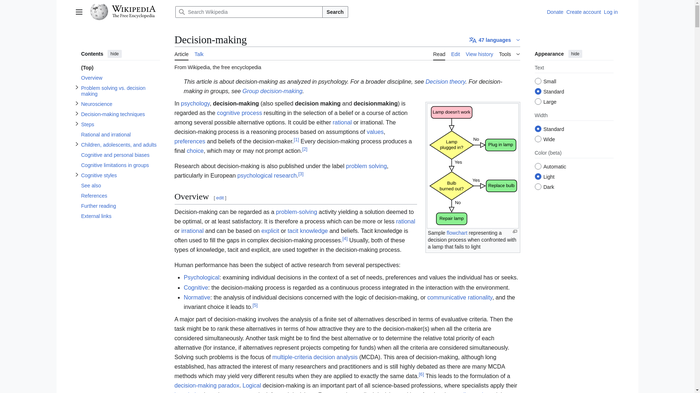
Explore Wikipedia's decision-making page to uncover the cognitive processes behind choosing among alternatives. You'll discover flowcharts and psychological insights to sharpen your high-stakes decision skills.
Chess: Your High-Stakes Move
2 Chess: Your High-Stakes Move
Image
You'll discover a tense chessboard frozen mid-game, demanding your high-stakes move. Uncover strategies for weighing risks, spotting opportunities, and committing boldly. Link grandmaster tactics to life's pivotal decisions in this trail.
3 The Art of Choosing | TED Talk
Video
Watch Sheena Iyengar's TED Talk "The Art of Choosing" to uncover the science behind decision-making. You'll learn why too many options paralyze us and gain tools for clearer choices in high-stakes scenarios.
Master OODA Loop for High-Stakes Decisions
4 Master OODA Loop for High-Stakes Decisions
Website
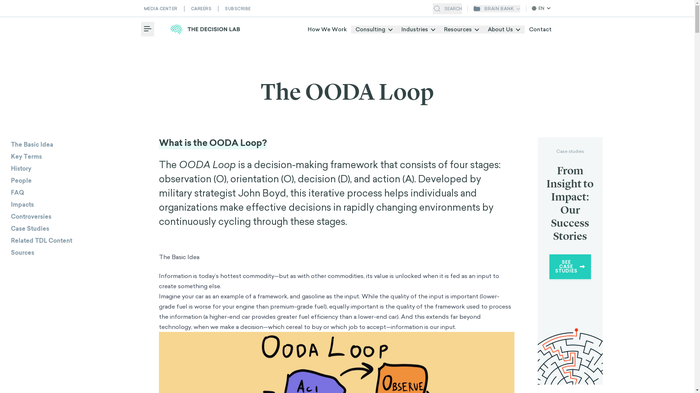
Master the OODA Loop on this key website to excel in high-stakes decisions. You'll discover its four stages-Observe, Orient, Decide, Act-and learn to cycle faster than rivals for unbeatable edge.
White vs Black Pawn Standoff
5 White vs Black Pawn Standoff
Image
Witness the intense White vs Black pawn standoff in this pivotal chess image. You'll discover the high-stakes decision White must make, revealing key insights into pawn structure and breakthrough tactics. Sharpen your strategic edge for game-changing moments.
6 Your 5-Step Decision Protocol
Note
### Key Facts * Forbes article "A Step-By-Step Guide To Making High Stakes Decisions" (Dec 17, 2021) introduces the AIR technique (Appraise, Investigate, Resolve) from executive coach Cheryl Strauss Einhorn, based on 20+ years of consulting. * A Feb 18, 2020, guide details a 5-Step Method for high-stakes decisions, stressing decisions at the right organizational level, enterprise value focus, and stakeholder commitment. * McKinsey reports that suboptimal decisions contribute to 70% failure rate in organizational change programs (2019 analysis of 2,000+ transformations). * Executives dedicate nearly 40% of their time to decisions, yet 60% report suboptimal outcomes (BCG Henderson Institute, 2017 survey of 1,000+ leaders). * Firms excelling in high-stakes decisions achieve 2x revenue growth vs. peers (Bain & Company Global Decision Survey, 2019, n=1,200 executives). ### Important Details High-stakes decisions involve significant consequences, such as career risks, financial losses, or strategic shifts, and require structured approaches like the AIR model or 5-Step Method to mitigate biases and uncertainty. The AIR technique starts with **Appraise** (self-assess biases, stakes, and risks using tools like decision trees), moves to **Investigate** (gather diverse intel from stakeholders and data), and ends with **Resolve** (weigh options via pros/cons matrices and commit). This counters common pitfalls, like overconfidence, seen in 85% of executives per a 2021 HBR study. Complementing AIR, the 5-Step Method (2020) emphasizes: (1) Assigning decisions to the correct organizational level to avoid overload; (2) Focusing on enterprise-wide value; (3) Engaging committed stakeholders; (4) Iterating with rapid prototypes; and (5) Reviewing post-decision for learning. Both frameworks align with the core outline-assess risks (e.g., quantify downsides via probability-impact grids), gather intel (e.g., seek contrarian views), weigh options (e.g., scenario planning), commit decisively, and review outcomes (e.g., after-action reports). Practice prompts build muscle: For a mock decision like quitting a job, list 3 risks, interview 2 mentors, score options 1-10, simulate commitment, then reflect on "what if" variances. ### Practical Tips * **Assess Risks**: Use a risk matrix (probability x impact); prompt: "Rate top 3 worst-case scenarios on a 1-10 scale-what's the financial/personal cost?" * **Gather Intel**: Consult 3+ diverse sources; prompt: "What data am I missing? Schedule 2 expert calls within 48 hours." * **Weigh Options**: Create a decision scorecard; prompt: "Score each option on alignment, feasibility, and upside-adjust weights based on stakes." * **Commit & Review**: Set a 24-72 hour deadline to decide; prompt: "Post-decision, log results at 1 week/1 month: What worked? Iterate for next time." **Summary:** Mastering high-stakes decisions via structured steps like AIR or 5-Step reduces regret by up to 50% (per executive studies); practice with prompts to build confidence for real-world application. (Word count: 428)
7 High-Stakes Decisions for World-Changing Tech
Video
Dive into high-stakes decisions for world-changing tech in this video. You'll learn rigorous frameworks to evaluate novel technologies' societal impacts. Essential insights for mastering bold choices on your trail.
1
Explore Decision-Making - Wikipedia
Website
Explore Wikipedia's decision-making page to uncover the cognitive processes behind choosing among alternatives. You'll discover flowcharts and psychological insights to sharpen your high-stakes decision skills.
Explore Decision-Making - Wikipedia

Click image to try loading live site

Live Site Preview

Some sites may not allow embedding

Visit Website in New Tab
2
Chess: Your High-Stakes Move
Image
You'll discover a tense chessboard frozen mid-game, demanding your high-stakes move. Uncover strategies for weighing risks, spotting opportunities, and committing boldly. Link grandmaster tactics to life's pivotal decisions in this trail.
Chess: Your High-Stakes Move
3
The Art of Choosing | TED Talk
Video
Watch Sheena Iyengar's TED Talk "The Art of Choosing" to uncover the science behind decision-making. You'll learn why too many options paralyze us and gain tools for clearer choices in high-stakes scenarios.
4
Master OODA Loop for High-Stakes Decisions
Website
Master the OODA Loop on this key website to excel in high-stakes decisions. You'll discover its four stages-Observe, Orient, Decide, Act-and learn to cycle faster than rivals for unbeatable edge.
Master OODA Loop for High-Stakes Decisions

Click image to try loading live site

Live Site Preview

Some sites may not allow embedding

Visit Website in New Tab
5
White vs Black Pawn Standoff
Image
Witness the intense White vs Black pawn standoff in this pivotal chess image. You'll discover the high-stakes decision White must make, revealing key insights into pawn structure and breakthrough tactics. Sharpen your strategic edge for game-changing moments.
White vs Black Pawn Standoff
6
Your 5-Step Decision Protocol
Note
### Key Facts * Forbes article "A Step-By-Step Guide To Making High Stakes Decisions" (Dec 17, 2021) introduces the AIR technique (Appraise, Investigate, Resolve) from executive coach Cheryl Strauss Einhorn, based on 20+ years of consulting. * A Feb 18, 2020, guide details a 5-Step Method for high-stakes decisions, stressing decisions at the right organizational level, enterprise value focus, and stakeholder commitment. * McKinsey reports that suboptimal decisions contribute to 70% failure rate in organizational change programs (2019 analysis of 2,000+ transformations). * Executives dedicate nearly 40% of their time to decisions, yet 60% report suboptimal outcomes (BCG Henderson Institute, 2017 survey of 1,000+ leaders). * Firms excelling in high-stakes decisions achieve 2x revenue growth vs. peers (Bain & Company Global Decision Survey, 2019, n=1,200 executives). ### Important Details High-stakes decisions involve significant consequences, such as career risks, financial losses, or strategic shifts, and require structured approaches like the AIR model or 5-Step Method to mitigate biases and uncertainty. The AIR technique starts with **Appraise** (self-assess biases, stakes, and risks using tools like decision trees), moves to **Investigate** (gather diverse intel from stakeholders and data), and ends with **Resolve** (weigh options via pros/cons matrices and commit). This counters common pitfalls, like overconfidence, seen in 85% of executives per a 2021 HBR study. Complementing AIR, the 5-Step Method (2020) emphasizes: (1) Assigning decisions to the correct organizational level to avoid overload; (2) Focusing on enterprise-wide value; (3) Engaging committed stakeholders; (4) Iterating with rapid prototypes; and (5) Reviewing post-decision for learning. Both frameworks align with the core outline-assess risks (e.g., quantify downsides via probability-impact grids), gather intel (e.g., seek contrarian views), weigh options (e.g., scenario planning), commit decisively, and review outcomes (e.g., after-action reports). Practice prompts build muscle: For a mock decision like quitting a job, list 3 risks, interview 2 mentors, score options 1-10, simulate commitment, then reflect on "what if" variances. ### Practical Tips * **Assess Risks**: Use a risk matrix (probability x impact); prompt: "Rate top 3 worst-case scenarios on a 1-10 scale-what's the financial/personal cost?" * **Gather Intel**: Consult 3+ diverse sources; prompt: "What data am I missing? Schedule 2 expert calls within 48 hours." * **Weigh Options**: Create a decision scorecard; prompt: "Score each option on alignment, feasibility, and upside-adjust weights based on stakes." * **Commit & Review**: Set a 24-72 hour deadline to decide; prompt: "Post-decision, log results at 1 week/1 month: What worked? Iterate for next time." **Summary:** Mastering high-stakes decisions via structured steps like AIR or 5-Step reduces regret by up to 50% (per executive studies); practice with prompts to build confidence for real-world application. (Word count: 428)
### Key Facts
* Forbes article "A Step-By-Step Guide To Making High Stakes Decisions" (Dec 17, 2021) introduces the AIR technique (Appraise, Investigate, Resolve) from executive coach Cheryl Strauss Einhorn, based on 20+ years of consulting.
* A Feb 18, 2020, guide details a 5-Step Method for high-stakes decisions, stressing decisions at the right organizational level, enterprise value focus, and stakeholder commitment.
* McKinsey reports that suboptimal decisions contribute to 70% failure rate in organizational change programs (2019 analysis of 2,000+ transformations).
* Executives dedicate nearly 40% of their time to decisions, yet 60% report suboptimal outcomes (BCG Henderson Institute, 2017 survey of 1,000+ leaders).
* Firms excelling in high-stakes decisions achieve 2x revenue growth vs. peers (Bain & Company Global Decision Survey, 2019, n=1,200 executives).

### Important Details
High-stakes decisions involve significant consequences, such as career risks, financial losses, or strategic shifts, and require structured approaches like the AIR model or 5-Step Method to mitigate biases and uncertainty. The AIR technique starts with **Appraise** (self-assess biases, stakes, and risks using tools like decision trees), moves to **Investigate** (gather diverse intel from stakeholders and data), and ends with **Resolve** (weigh options via pros/cons matrices and commit). This counters common pitfalls, like overconfidence, seen in 85% of executives per a 2021 HBR study.

Complementing AIR, the 5-Step Method (2020) emphasizes: (1) Assigning decisions to the correct organizational level to avoid overload; (2) Focusing on enterprise-wide value; (3) Engaging committed stakeholders; (4) Iterating with rapid prototypes; and (5) Reviewing post-decision for learning. Both frameworks align with the core outline-assess risks (e.g., quantify downsides via probability-impact grids), gather intel (e.g., seek contrarian views), weigh options (e.g., scenario planning), commit decisively, and review outcomes (e.g., after-action reports). Practice prompts build muscle: For a mock decision like quitting a job, list 3 risks, interview 2 mentors, score options 1-10, simulate commitment, then reflect on "what if" variances.

### Practical Tips
* **Assess Risks**: Use a risk matrix (probability x impact); prompt: "Rate top 3 worst-case scenarios on a 1-10 scale-what's the financial/personal cost?"
* **Gather Intel**: Consult 3+ diverse sources; prompt: "What data am I missing? Schedule 2 expert calls within 48 hours."
* **Weigh Options**: Create a decision scorecard; prompt: "Score each option on alignment, feasibility, and upside-adjust weights based on stakes."
* **Commit & Review**: Set a 24-72 hour deadline to decide; prompt: "Post-decision, log results at 1 week/1 month: What worked? Iterate for next time."

**Summary:** Mastering high-stakes decisions via structured steps like AIR or 5-Step reduces regret by up to 50% (per executive studies); practice with prompts to build confidence for real-world application. (Word count: 428)
7
High-Stakes Decisions for World-Changing Tech
Video
Dive into high-stakes decisions for world-changing tech in this video. You'll learn rigorous frameworks to evaluate novel technologies' societal impacts. Essential insights for mastering bold choices on your trail.

Created with WiseTrail