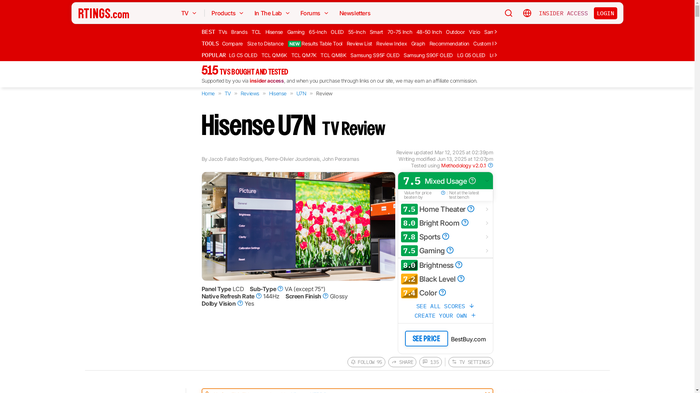
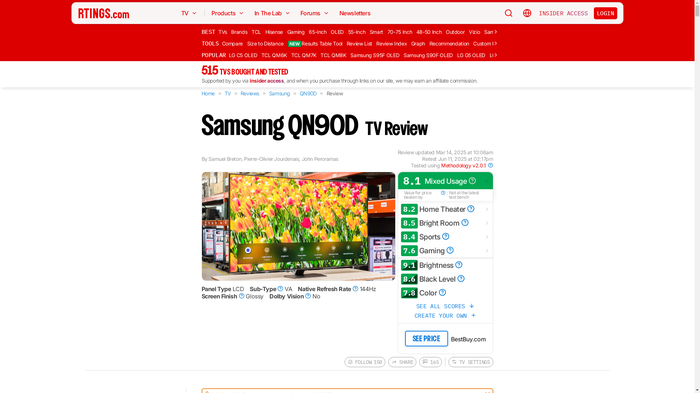
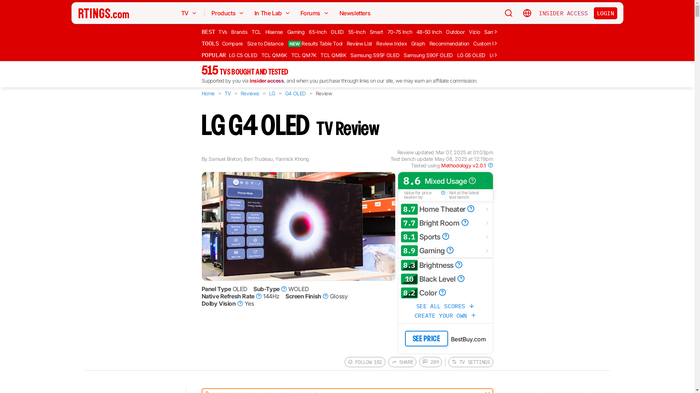
When shopping for a gaming TV, understanding the key specs ensures you get smooth, responsive performance without blur, tearing, or washed-out visuals. This step breaks down the essentials, tailored for gamers chasing 4K at 120-144Hz with low lag. We'll explain each term simply, why it matters for gaming, and real-world benchmarks from 2025 models like the LG G5 OLED, Samsung S95D QD-OLED, and Sony Bravia 9 Mini-LED.
### Resolution
Resolution is the number of pixels on screen-higher means sharper detail. **4K UHD (3840x2160)** is essential for gaming today, delivering crisp textures in games like Cyberpunk 2077 on PS5 or PC. **8K (7680x4320)** doubles that but is overkill unless you have a massive 85"+ screen and 8K content; it won't boost frame rates and costs 2-3x more. Stick to 4K for value-e.g., the LG G5 hits native 4K at 144Hz.
### Refresh Rate
This is how many times per second the screen updates (Hz). **60Hz** is basic for casual viewing but stutters in fast games. **120-144Hz** is ideal for fluid motion in shooters like Call of Duty, matching console/PC output. Native 144Hz panels (not upscaled) like the Samsung S95D handle it best, reducing judder without soap-opera effect.
### HDMI 2.1
The port standard for next-gen gaming. **HDMI 2.1** provides full 48Gbps bandwidth for 4K/120Hz+ with no compression. Key features:
- **VRR (Variable Refresh Rate)**: Syncs TV refresh to game frame rate (e.g., Nvidia G-Sync, AMD FreeSync), eliminating screen tearing.
- **ALLM (Auto Low Latency Mode)**: Auto-switches to game mode for <13ms input lag.
- **eARC**: Lossless audio passthrough for soundbars.
Look for 2-4 HDMI 2.1 ports-Sony Bravia 9 has four, perfect for PS5 + PC.
### Input Lag
Time from controller input to on-screen action (measured in ms). **<13ms** is ideal for competitive play; anything over 20ms feels sluggish. Game Mode TVs like the LG G5 achieve 9-12ms at 4K/144Hz.
### Brightness (Peak Nits)
Measured in nits (lumens per square meter), this is how bright the TV gets. **1000+ nits** sustains HDR "pop" in bright rooms, combating glare. OLEDs like Samsung S95D hit 1600 nits peaks; Mini-LEDs like Sony Bravia 9 exceed 3000 nits for daylight gaming.
### Contrast Ratio
How well blacks look vs. whites. **Infinite contrast** on OLED (self-emissive pixels turn off for pure black). LCDs use **local dimming zones** (hundreds/thousands) for deep blacks-Sony Bravia 9 has 3000+ zones. Avoid low-zone budget TVs that halo around bright objects.
### Panel Type
- **OLED**: Perfect blacks, <1ms response time (no motion blur), infinite contrast, but burn-in risk with static HUDs. LG G5 excels here.
- **QLED/Mini-LED**: Brighter for HDR/sports, no burn-in, but higher response times (2-5ms). Samsung S95D QD-OLED blends both.
Choose OLED for dark-room immersion; Mini-LED for versatility.
### Response Time
Pixel transition speed (gray-to-gray, ms). **<5ms ideal, <1ms on OLED** prevents ghosting in fast action. All top 2025 gaming TVs hit this-e.g., LG G5 at 0.1ms.
Prioritize TVs with ALL these: 4K/144Hz, HDMI 2.1 VRR, <13ms lag, 1000+ nits. Test in-store for lag via demo games. (Word count: 478)