WiseTrail

AI & ML Basics: From Zero to Hero

By wiseman   |   Technology
Create Trail
Share Tweet Share
Link copied to clipboard!
1 Explore AI on Wikipe...
2 Machine Learning Dia...
3 Supervised vs Unsupe...
4 10 ML Examples You U...
5 Speedcurve Performan...
6 Trail Wrap-Up: Your ...
1 Explore AI on Wikipedia Website
Explore AI on Wikipedia
2 Machine Learning Diagram Unveiled Image
Machine Learning Diagram Unveiled
3 Supervised vs Unsupervised vs Reinforcement Learning Website
Supervised vs Unsupervised vs Reinforcement Learning
4 10 ML Examples You Use Every Day Video
5 Speedcurve Performance Analytics Dashboard Image
Speedcurve Performance Analytics Dashboard
6 Trail Wrap-Up: Your AI Journey Note
Explore AI on Wikipedia
1 Explore AI on Wikipedia
Website
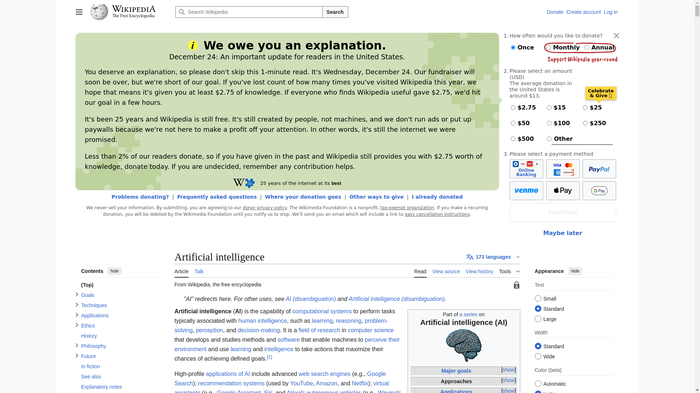
Dive into AI's Wikipedia page to uncover its 1956 founding, cycles of optimism and "AI winters," and the 2012 funding surge with GPUs. You'll gain key historical insights that ground your understanding of AI and Machine Learning basics.
Machine Learning Diagram Unveiled
2 Machine Learning Diagram Unveiled
Image
Unveil this insightful machine learning diagram in our AI and Machine Learning Basics trail. You'll discover the core workflow from data input to predictions, demystifying how AI truly learns and powers intelligent systems.
Supervised vs Unsupervised vs Reinforcement Learning
3 Supervised vs Unsupervised vs Reinforcement Learning
Website
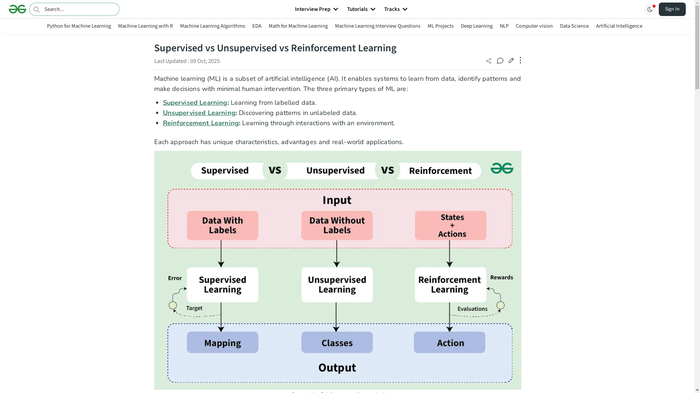
Discover the core differences between Supervised, Unsupervised, and Reinforcement Learning on this essential website. You'll learn how labeled data, hidden patterns, and rewards power AI, building your Machine Learning Basics foundation.
4 10 ML Examples You Use Every Day
Video
You'll discover 10 practical machine learning examples powering your daily life, from smartphone apps to healthcare. This video reveals how ML works behind the scenes, building your grasp of AI basics.
Speedcurve Performance Analytics Dashboard
5 Speedcurve Performance Analytics Dashboard
Image
Discover the SpeedCurve Performance Analytics Dashboard, revealing AI-driven insights into web speed and user experience. You'll uncover key metrics like Core Web Vitals and optimization trends, connecting performance analytics to AI and machine learning basics.
6 Trail Wrap-Up: Your AI Journey
Note
### Key Facts * The term "Artificial Intelligence" (AI) was coined in 1956 at the Dartmouth Conference by John McCarthy, Marvin Minsky, Nathaniel Rochester, and Claude Shannon, marking the birth of AI as a field. * "Machine Learning" (ML) was first defined by Arthur Samuel in 1959 while developing a checkers-playing program at IBM, describing it as computers' ability to learn without explicit programming. * ML is a subset of AI; supervised learning (a common ML type) powers ~70% of real-world applications like spam detection, per industry reports from sources like GeeksforGeeks. * Andrew Ng's "Machine Learning" course on Coursera, launched in 2011, has over 4.8 million enrollments as of 2023, making it one of the most popular free AI intros. * Kaggle, founded in 2010, hosts over 100,000 public datasets and has 15 million+ users practicing ML hands-on. ### Overview Artificial Intelligence (AI) refers to systems that mimic human intelligence to perform tasks like reasoning, learning, and problem-solving. Machine Learning (ML), a key subset of AI, focuses on algorithms that enable computers to learn patterns from data without being explicitly programmed for every scenario. As noted in Google Developers' "Machine Learning & Artificial Intelligence Basics" (a 10-minute read), this allows machines to improve performance over time through experience. ### Important Details ML algorithms analyze datasets to identify trends and make predictions. Core types include supervised learning (using labeled data for tasks like classification or regression), unsupervised learning (finding hidden patterns in unlabeled data, e.g., clustering customers), and reinforcement learning (learning via trial-and-error rewards, powering tools like AlphaGo). GeeksforGeeks emphasizes that ML "teaches systems to think and understand like humans" by processing vast data volumes-modern models like GPT series train on trillions of tokens. Applications span industries: Netflix's recommendation engine (ML-driven) retains users via 75% personalized suggestions; healthcare uses ML for early disease detection with 90%+ accuracy in some models; autonomous vehicles from Tesla process 1.3 million miles of data daily. Since the 2012 AlexNet breakthrough in image recognition (reducing error rates from 25% to 15% on ImageNet), deep learning-a neural network-based ML subset-has fueled explosive growth, with the global AI market projected to reach $1.8 trillion by 2030. ### Tips/Next Steps * Dive into Google's free "Machine Learning Crash Course" (developers.google.com/machine-learning/crash-course)-complete it in 15 hours for hands-on TensorFlow basics. * Audit Andrew Ng's "Machine Learning" on Coursera (coursera.org/learn/machine-learning) for free; pair it with Kaggle datasets (kaggle.com/datasets) to build your first model, like predicting house prices. * Practice daily: Join Kaggle competitions (free entry) or GeeksforGeeks ML tutorials for Python code examples. **Summary:** This trail recapped AI/ML fundamentals-from 1956 origins to modern data-driven learning-equipping you to explore real applications. Next, tackle free Coursera/Kaggle resources to build practical skills and launch your journey.** (Word count: 428)
1
Explore AI on Wikipedia
Website
Dive into AI's Wikipedia page to uncover its 1956 founding, cycles of optimism and "AI winters," and the 2012 funding surge with GPUs. You'll gain key historical insights that ground your understanding of AI and Machine Learning basics.
Explore AI on Wikipedia

Click image to try loading live site

Live Site Preview

Some sites may not allow embedding

Visit Website in New Tab
2
Machine Learning Diagram Unveiled
Image
Unveil this insightful machine learning diagram in our AI and Machine Learning Basics trail. You'll discover the core workflow from data input to predictions, demystifying how AI truly learns and powers intelligent systems.
Machine Learning Diagram Unveiled
3
Supervised vs Unsupervised vs Reinforcement Learning
Website
Discover the core differences between Supervised, Unsupervised, and Reinforcement Learning on this essential website. You'll learn how labeled data, hidden patterns, and rewards power AI, building your Machine Learning Basics foundation.
Supervised vs Unsupervised vs Reinforcement Learning

Click image to try loading live site

Live Site Preview

Some sites may not allow embedding

Visit Website in New Tab
4
10 ML Examples You Use Every Day
Video
You'll discover 10 practical machine learning examples powering your daily life, from smartphone apps to healthcare. This video reveals how ML works behind the scenes, building your grasp of AI basics.
5
Speedcurve Performance Analytics Dashboard
Image
Discover the SpeedCurve Performance Analytics Dashboard, revealing AI-driven insights into web speed and user experience. You'll uncover key metrics like Core Web Vitals and optimization trends, connecting performance analytics to AI and machine learning basics.
Speedcurve Performance Analytics Dashboard
6
Trail Wrap-Up: Your AI Journey
Note
### Key Facts * The term "Artificial Intelligence" (AI) was coined in 1956 at the Dartmouth Conference by John McCarthy, Marvin Minsky, Nathaniel Rochester, and Claude Shannon, marking the birth of AI as a field. * "Machine Learning" (ML) was first defined by Arthur Samuel in 1959 while developing a checkers-playing program at IBM, describing it as computers' ability to learn without explicit programming. * ML is a subset of AI; supervised learning (a common ML type) powers ~70% of real-world applications like spam detection, per industry reports from sources like GeeksforGeeks. * Andrew Ng's "Machine Learning" course on Coursera, launched in 2011, has over 4.8 million enrollments as of 2023, making it one of the most popular free AI intros. * Kaggle, founded in 2010, hosts over 100,000 public datasets and has 15 million+ users practicing ML hands-on. ### Overview Artificial Intelligence (AI) refers to systems that mimic human intelligence to perform tasks like reasoning, learning, and problem-solving. Machine Learning (ML), a key subset of AI, focuses on algorithms that enable computers to learn patterns from data without being explicitly programmed for every scenario. As noted in Google Developers' "Machine Learning & Artificial Intelligence Basics" (a 10-minute read), this allows machines to improve performance over time through experience. ### Important Details ML algorithms analyze datasets to identify trends and make predictions. Core types include supervised learning (using labeled data for tasks like classification or regression), unsupervised learning (finding hidden patterns in unlabeled data, e.g., clustering customers), and reinforcement learning (learning via trial-and-error rewards, powering tools like AlphaGo). GeeksforGeeks emphasizes that ML "teaches systems to think and understand like humans" by processing vast data volumes-modern models like GPT series train on trillions of tokens. Applications span industries: Netflix's recommendation engine (ML-driven) retains users via 75% personalized suggestions; healthcare uses ML for early disease detection with 90%+ accuracy in some models; autonomous vehicles from Tesla process 1.3 million miles of data daily. Since the 2012 AlexNet breakthrough in image recognition (reducing error rates from 25% to 15% on ImageNet), deep learning-a neural network-based ML subset-has fueled explosive growth, with the global AI market projected to reach $1.8 trillion by 2030. ### Tips/Next Steps * Dive into Google's free "Machine Learning Crash Course" (developers.google.com/machine-learning/crash-course)-complete it in 15 hours for hands-on TensorFlow basics. * Audit Andrew Ng's "Machine Learning" on Coursera (coursera.org/learn/machine-learning) for free; pair it with Kaggle datasets (kaggle.com/datasets) to build your first model, like predicting house prices. * Practice daily: Join Kaggle competitions (free entry) or GeeksforGeeks ML tutorials for Python code examples. **Summary:** This trail recapped AI/ML fundamentals-from 1956 origins to modern data-driven learning-equipping you to explore real applications. Next, tackle free Coursera/Kaggle resources to build practical skills and launch your journey.** (Word count: 428)
### Key Facts
* The term "Artificial Intelligence" (AI) was coined in 1956 at the Dartmouth Conference by John McCarthy, Marvin Minsky, Nathaniel Rochester, and Claude Shannon, marking the birth of AI as a field.
* "Machine Learning" (ML) was first defined by Arthur Samuel in 1959 while developing a checkers-playing program at IBM, describing it as computers' ability to learn without explicit programming.
* ML is a subset of AI; supervised learning (a common ML type) powers ~70% of real-world applications like spam detection, per industry reports from sources like GeeksforGeeks.
* Andrew Ng's "Machine Learning" course on Coursera, launched in 2011, has over 4.8 million enrollments as of 2023, making it one of the most popular free AI intros.
* Kaggle, founded in 2010, hosts over 100,000 public datasets and has 15 million+ users practicing ML hands-on.

### Overview
Artificial Intelligence (AI) refers to systems that mimic human intelligence to perform tasks like reasoning, learning, and problem-solving. Machine Learning (ML), a key subset of AI, focuses on algorithms that enable computers to learn patterns from data without being explicitly programmed for every scenario. As noted in Google Developers' "Machine Learning & Artificial Intelligence Basics" (a 10-minute read), this allows machines to improve performance over time through experience.

### Important Details
ML algorithms analyze datasets to identify trends and make predictions. Core types include supervised learning (using labeled data for tasks like classification or regression), unsupervised learning (finding hidden patterns in unlabeled data, e.g., clustering customers), and reinforcement learning (learning via trial-and-error rewards, powering tools like AlphaGo). GeeksforGeeks emphasizes that ML "teaches systems to think and understand like humans" by processing vast data volumes-modern models like GPT series train on trillions of tokens.

Applications span industries: Netflix's recommendation engine (ML-driven) retains users via 75% personalized suggestions; healthcare uses ML for early disease detection with 90%+ accuracy in some models; autonomous vehicles from Tesla process 1.3 million miles of data daily. Since the 2012 AlexNet breakthrough in image recognition (reducing error rates from 25% to 15% on ImageNet), deep learning-a neural network-based ML subset-has fueled explosive growth, with the global AI market projected to reach $1.8 trillion by 2030.

### Tips/Next Steps
* Dive into Google's free "Machine Learning Crash Course" (developers.google.com/machine-learning/crash-course)-complete it in 15 hours for hands-on TensorFlow basics.
* Audit Andrew Ng's "Machine Learning" on Coursera (coursera.org/learn/machine-learning) for free; pair it with Kaggle datasets (kaggle.com/datasets) to build your first model, like predicting house prices.
* Practice daily: Join Kaggle competitions (free entry) or GeeksforGeeks ML tutorials for Python code examples.

**Summary:** This trail recapped AI/ML fundamentals-from 1956 origins to modern data-driven learning-equipping you to explore real applications. Next, tackle free Coursera/Kaggle resources to build practical skills and launch your journey.** (Word count: 428)

Created with WiseTrail