WiseTrail

Master Study Habits: Learn Smarter, Not Harder

By wiseman   |   Education
Create Trail
Discover science-backed study techniques to supercharge your learning efficiency and retention. From spaced repetition to the Feynman method, this trail covers essential strategies step-by-step. End with a customizable action plan to transform your academic performance.
Share Tweet Share
Link copied to clipboard!
1 Explore Study Skills...
2 Brain in Black & Whi...
3 Master Coding with A...
4 Feynman Technique fo...
5 Portugal COVID-19 Ca...
6 Your Personalized St...
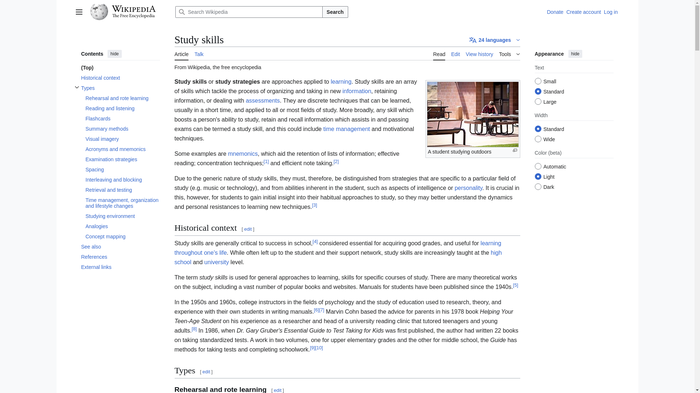
1 Explore Study Skills on Wikipedia Website
Explore Study Skills on Wikipedia
2 Brain in Black & White Image
Brain in Black & White
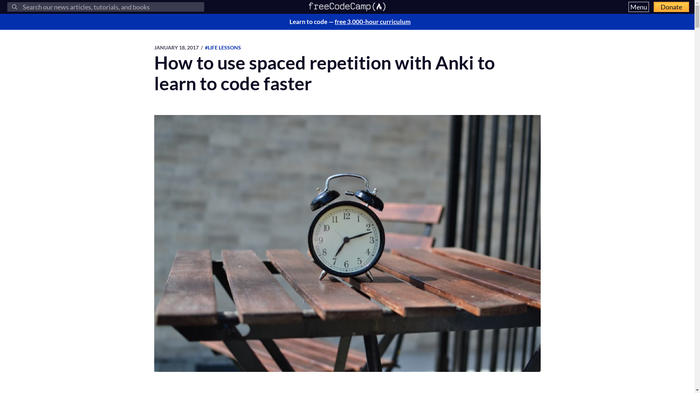
3 Master Coding with Anki Spaced Repetition Website
Master Coding with Anki Spaced Repetition
4 Feynman Technique for Beginners Video
5 Portugal COVID-19 Cases (20.04.2020) Image
Portugal COVID-19 Cases (20.04.2020)
6 Your Personalized Study Mastery Plan Note
Explore Study Skills on Wikipedia
1 Explore Study Skills on Wikipedia
Website
Explore Study Skills on Wikipedia. You'll uncover techniques for organizing info, boosting retention, and acing assessments, empowering your learning journey.
Brain in Black & White
2 Brain in Black & White
Image
Behold the human brain in stark black and white, revealing its intricate gyri and sulci. You'll discover how these structures underpin cognition and emotion. Ties into our trail's deep dive into neural wonders.
Master Coding with Anki Spaced Repetition
3 Master Coding with Anki Spaced Repetition
Website
Discover how to supercharge your coding skills with Anki's spaced repetition in Steven Gilbert's guide. You'll learn techniques to retain fundamentals, commands, and best practices effortlessly. Accelerate your mastery on this coding trail!
4 Feynman Technique for Beginners
Video
Discover the Feynman Technique for beginners in this engaging video with Naomi. You'll learn a simple, powerful method to master any topic by explaining it like you're teaching a child. Join 160k+ people supercharging their learning in this productivity trail.
Portugal COVID-19 Cases (20.04.2020)
5 Portugal COVID-19 Cases (20.04.2020)
Image
Discover Portugal's COVID-19 case snapshot from 20.04.2020 in this revealing image. You'll uncover confirmed cases, deaths, and trends during the first European wave, highlighting the pandemic's rapid escalation.
6 Your Personalized Study Mastery Plan
Note
### Key Facts - Ebbinghaus Forgetting Curve (1885): Without review, learners forget ~50% of new information within 1 hour, ~70% within 24 hours, and ~90% within a week. - Dunlosky et al. (2013) meta-analysis: Active recall (practice testing) ranks #1 in learning utility, boosting long-term retention by 50-100% over passive rereading. - Cepeda et al. (2006) study: Spaced repetition expands intervals (e.g., review at 1 day, 1 week, 1 month), improving retention by 200% vs. cramming. - Rohrer & Taylor (2007): Interleaved practice (mixing topics) yields 43% higher math performance than blocked practice after 1 week. - Pomodoro Technique (Cirillo, 1980s): 25-minute focused sessions with 5-minute breaks align with attention research showing peak focus drops after 25-30 minutes (e.g., NASA studies on vigilance). ### Overview This final step recaps the trail's core techniques-active recall, spaced repetition, interleaved practice, Pomodoro timing, Feynman simplification, and dual coding-proven by decades of cognitive science to transform inefficient studying into high-retention mastery. These methods counter natural forgetting and build durable knowledge, with studies showing 2-3x efficiency gains for students applying them consistently. ### Important Details Throughout the trail, we've explored evidence-based strategies rooted in learning psychology. Active recall forces retrieval from memory, outperforming highlighting (which has low utility per Dunlosky). Spaced repetition leverages the spacing effect, scheduling reviews via tools like Anki, where users report 90% retention rates after 6 months. Interleaving mimics real-world application, enhancing problem-solving, while Pomodoro combats procrastination by structuring sessions around ultradian rhythms (90-120 minute cycles). Feynman Technique (named after physicist Richard Feynman, 1960s) involves explaining concepts simply to expose gaps, and dual coding (Paivio, 1971) combines words + visuals for 40-60% better recall. As Step 7 of 7, reflect on your progress: Which technique yielded the biggest gains? Track metrics like pre/post-test scores to quantify improvement-aim for 20-30% weekly retention boosts. **Custom Study Schedule Template** | Time Slot | Technique | Subject/Task | Duration | Notes/Reflection | |-----------|-----------|--------------|----------|-----------------| | 9-9:25 AM | Pomodoro + Active Recall | Math Ch. 5 | 25 min | Quiz 10 problems | | 9:30-10:20 AM | Spaced Repetition | Vocab Review | 50 min | Anki deck | | 10:25-11:15 AM | Interleaving + Feynman | History/Science | 50 min | Teach aloud | | Afternoon | Dual Coding | Notes Revision | 90 min | Mind maps | *Weekly goal: 15-20 hours, 80% active techniques. Adjust based on energy peaks (e.g., mornings for deep work).* ### Tips/Next Steps - **Reflect:** Journal: "What blocked me? How did spacing change retention?" Review weekly. - **Implement:** Build your schedule using the template; use apps like Forest (Pomodoro) or Anki. Test with a 1-week trial, measuring recall accuracy. - **Scale Up:** Join a study group for interleaved challenges; track progress in a log for 30 days to solidify habits. **Summary:** Mastering these techniques equips you for lifelong learning, backed by science showing dramatic retention gains. Customize and commit to your schedule now for sustained academic success.** (378 words)
1
Explore Study Skills on Wikipedia
Website
Explore Study Skills on Wikipedia. You'll uncover techniques for organizing info, boosting retention, and acing assessments, empowering your learning journey.
Explore Study Skills on Wikipedia

Click image to try loading live site

Live Site Preview

Some sites may not allow embedding

Visit Website in New Tab
2
Brain in Black & White
Image
Behold the human brain in stark black and white, revealing its intricate gyri and sulci. You'll discover how these structures underpin cognition and emotion. Ties into our trail's deep dive into neural wonders.
Brain in Black & White
3
Master Coding with Anki Spaced Repetition
Website
Discover how to supercharge your coding skills with Anki's spaced repetition in Steven Gilbert's guide. You'll learn techniques to retain fundamentals, commands, and best practices effortlessly. Accelerate your mastery on this coding trail!
Master Coding with Anki Spaced Repetition

Click image to try loading live site

Live Site Preview

Some sites may not allow embedding

Visit Website in New Tab
4
Feynman Technique for Beginners
Video
Discover the Feynman Technique for beginners in this engaging video with Naomi. You'll learn a simple, powerful method to master any topic by explaining it like you're teaching a child. Join 160k+ people supercharging their learning in this productivity trail.
5
Portugal COVID-19 Cases (20.04.2020)
Image
Discover Portugal's COVID-19 case snapshot from 20.04.2020 in this revealing image. You'll uncover confirmed cases, deaths, and trends during the first European wave, highlighting the pandemic's rapid escalation.
Portugal COVID-19 Cases (20.04.2020)
6
Your Personalized Study Mastery Plan
Note
### Key Facts - Ebbinghaus Forgetting Curve (1885): Without review, learners forget ~50% of new information within 1 hour, ~70% within 24 hours, and ~90% within a week. - Dunlosky et al. (2013) meta-analysis: Active recall (practice testing) ranks #1 in learning utility, boosting long-term retention by 50-100% over passive rereading. - Cepeda et al. (2006) study: Spaced repetition expands intervals (e.g., review at 1 day, 1 week, 1 month), improving retention by 200% vs. cramming. - Rohrer & Taylor (2007): Interleaved practice (mixing topics) yields 43% higher math performance than blocked practice after 1 week. - Pomodoro Technique (Cirillo, 1980s): 25-minute focused sessions with 5-minute breaks align with attention research showing peak focus drops after 25-30 minutes (e.g., NASA studies on vigilance). ### Overview This final step recaps the trail's core techniques-active recall, spaced repetition, interleaved practice, Pomodoro timing, Feynman simplification, and dual coding-proven by decades of cognitive science to transform inefficient studying into high-retention mastery. These methods counter natural forgetting and build durable knowledge, with studies showing 2-3x efficiency gains for students applying them consistently. ### Important Details Throughout the trail, we've explored evidence-based strategies rooted in learning psychology. Active recall forces retrieval from memory, outperforming highlighting (which has low utility per Dunlosky). Spaced repetition leverages the spacing effect, scheduling reviews via tools like Anki, where users report 90% retention rates after 6 months. Interleaving mimics real-world application, enhancing problem-solving, while Pomodoro combats procrastination by structuring sessions around ultradian rhythms (90-120 minute cycles). Feynman Technique (named after physicist Richard Feynman, 1960s) involves explaining concepts simply to expose gaps, and dual coding (Paivio, 1971) combines words + visuals for 40-60% better recall. As Step 7 of 7, reflect on your progress: Which technique yielded the biggest gains? Track metrics like pre/post-test scores to quantify improvement-aim for 20-30% weekly retention boosts. **Custom Study Schedule Template** | Time Slot | Technique | Subject/Task | Duration | Notes/Reflection | |-----------|-----------|--------------|----------|-----------------| | 9-9:25 AM | Pomodoro + Active Recall | Math Ch. 5 | 25 min | Quiz 10 problems | | 9:30-10:20 AM | Spaced Repetition | Vocab Review | 50 min | Anki deck | | 10:25-11:15 AM | Interleaving + Feynman | History/Science | 50 min | Teach aloud | | Afternoon | Dual Coding | Notes Revision | 90 min | Mind maps | *Weekly goal: 15-20 hours, 80% active techniques. Adjust based on energy peaks (e.g., mornings for deep work).* ### Tips/Next Steps - **Reflect:** Journal: "What blocked me? How did spacing change retention?" Review weekly. - **Implement:** Build your schedule using the template; use apps like Forest (Pomodoro) or Anki. Test with a 1-week trial, measuring recall accuracy. - **Scale Up:** Join a study group for interleaved challenges; track progress in a log for 30 days to solidify habits. **Summary:** Mastering these techniques equips you for lifelong learning, backed by science showing dramatic retention gains. Customize and commit to your schedule now for sustained academic success.** (378 words)
### Key Facts
- Ebbinghaus Forgetting Curve (1885): Without review, learners forget ~50% of new information within 1 hour, ~70% within 24 hours, and ~90% within a week.
- Dunlosky et al. (2013) meta-analysis: Active recall (practice testing) ranks #1 in learning utility, boosting long-term retention by 50-100% over passive rereading.
- Cepeda et al. (2006) study: Spaced repetition expands intervals (e.g., review at 1 day, 1 week, 1 month), improving retention by 200% vs. cramming.
- Rohrer & Taylor (2007): Interleaved practice (mixing topics) yields 43% higher math performance than blocked practice after 1 week.
- Pomodoro Technique (Cirillo, 1980s): 25-minute focused sessions with 5-minute breaks align with attention research showing peak focus drops after 25-30 minutes (e.g., NASA studies on vigilance).

### Overview
This final step recaps the trail's core techniques-active recall, spaced repetition, interleaved practice, Pomodoro timing, Feynman simplification, and dual coding-proven by decades of cognitive science to transform inefficient studying into high-retention mastery. These methods counter natural forgetting and build durable knowledge, with studies showing 2-3x efficiency gains for students applying them consistently.

### Important Details
Throughout the trail, we've explored evidence-based strategies rooted in learning psychology. Active recall forces retrieval from memory, outperforming highlighting (which has low utility per Dunlosky). Spaced repetition leverages the spacing effect, scheduling reviews via tools like Anki, where users report 90% retention rates after 6 months. Interleaving mimics real-world application, enhancing problem-solving, while Pomodoro combats procrastination by structuring sessions around ultradian rhythms (90-120 minute cycles). Feynman Technique (named after physicist Richard Feynman, 1960s) involves explaining concepts simply to expose gaps, and dual coding (Paivio, 1971) combines words + visuals for 40-60% better recall.

As Step 7 of 7, reflect on your progress: Which technique yielded the biggest gains? Track metrics like pre/post-test scores to quantify improvement-aim for 20-30% weekly retention boosts.

**Custom Study Schedule Template**
| Time Slot | Technique | Subject/Task | Duration | Notes/Reflection |
|-----------|-----------|--------------|----------|-----------------|
| 9-9:25 AM | Pomodoro + Active Recall | Math Ch. 5 | 25 min | Quiz 10 problems |
| 9:30-10:20 AM | Spaced Repetition | Vocab Review | 50 min | Anki deck |
| 10:25-11:15 AM | Interleaving + Feynman | History/Science | 50 min | Teach aloud |
| Afternoon | Dual Coding | Notes Revision | 90 min | Mind maps |
*Weekly goal: 15-20 hours, 80% active techniques. Adjust based on energy peaks (e.g., mornings for deep work).*

### Tips/Next Steps
- **Reflect:** Journal: "What blocked me? How did spacing change retention?" Review weekly.
- **Implement:** Build your schedule using the template; use apps like Forest (Pomodoro) or Anki. Test with a 1-week trial, measuring recall accuracy.
- **Scale Up:** Join a study group for interleaved challenges; track progress in a log for 30 days to solidify habits.

**Summary:** Mastering these techniques equips you for lifelong learning, backed by science showing dramatic retention gains. Customize and commit to your schedule now for sustained academic success.** (378 words)

Created with WiseTrail